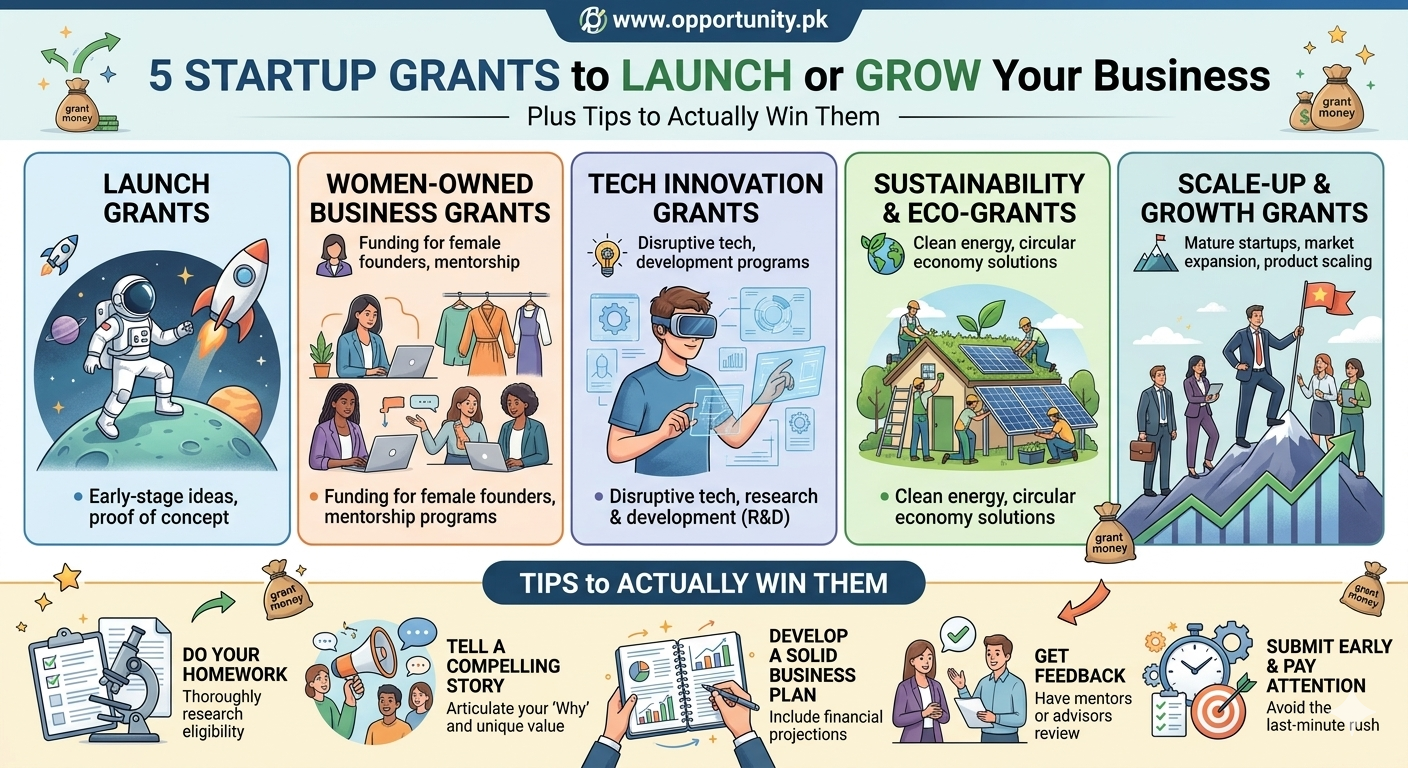
Starting or scaling a business takes capital, but not every founder wants to take on debt or give up equity. That’s where grants come in: free money that never has to be repaid.
Every year, millions of dollars in grant funding go unused simply because entrepreneurs don’t know where to look or how to apply properly.
After analyzing dozens of active opportunities (and drawing from the same kind of research you’d find on GrantWatch), here are five powerful startup grants – plus a bonus framework to boost your odds of winning.
1. The Amber Grant for Women Entrepreneurs
Who it’s for: Early‑stage businesses owned by women (U.S. and Canada).
Grant amount: $10,000 monthly winner + $25,000 annual grand prize.
Founded in 1998 to honor a young woman who died before realizing her business dreams, the Amber Grant has distributed over $2 million. Every month, one woman receives $10,000 – no strings attached, no equity required. At year end, a panel selects one of the 12 monthly winners for an extra $25,000.
Why it’s attractive:
- Minimal application (just a short description of your business and what you would do with the funds).
- Open to almost any industry (retail, services, manufacturing, tech).
- Also offers specific category grants (e.g., nonprofit, marketing, business expansion).
Typical uses of the grant: inventory, equipment, website development, marketing, or even paying yourself a small salary while you build.
2. IFundWomen Universal Grant Application
Who it’s for: Women‑owned businesses (with a growing number of opportunities for BIPOC and LGBTQ+ founders).
Grant amount: Varies by partner – commonly $2,000 to $25,000.
IFundWomen runs a “universal grant application.” You fill out one detailed profile about your business, and they match you to relevant grants from brands like Visa, Barbie, Bumble, and even government agencies.
Key features:
- Rolling deadlines – you can apply year‑round.
- Many grants are restricted to specific niches (e.g., eco‑friendly products, childcare, beauty, SaaS).
- Winners are often featured in brand campaigns, giving extra PR value.
Pro tip: IFundWomen also offers paid coaching, but the grant application itself is free. Take time on your “story” section – brands fund people as much as ideas.
3. Small Business Innovation Research (SBIR) & Small Business Technology Transfer (STTR)
Who it’s for: Tech‑driven startups working on scientific or engineering innovations.
Grant amount: Phase I: $50,000–$250,000; Phase II: up to $1.7 million.
This is the largest source of early‑stage, non‑dilutive funding in the U.S. Over a dozen federal agencies (including NSF, NIH, DoD, and NASA) participate. SBIR/STTR grants fund R&D that has a strong potential for commercialization.
How it works:
- Phase I – Feasibility study (6–12 months).
- Phase II – Prototype development (up to 2 years).
- Phase III – Commercialization (no SBIR funds, but you keep the IP).
Who wins:
- Startups with a strong scientific founder (PhD or deep industry experience).
- Clear understanding of the problem, solution, and market.
- Projects that align with a specific agency’s mission (e.g., health tech → NIH, clean energy → DOE).
Catch: The application is rigorous (often 25–50 pages). Many first‑time founders hire a grant writer, but you can learn by reading previously funded abstracts (all public on agency websites).
4. FedEx Small Business Grant Contest
Who it’s for: For‑profit small businesses with fewer than 99 employees, operating for at least six months.
Grant amount: Grand prize $50,000 + $7,500 in FedEx office services; smaller prizes $20,000 and $10,000.
Unlike a traditional grant, this is a contest. But because it’s cash with no repayment or equity, it functions as a grant for winners.
What judges look for:
- A compelling story (why did you start the business?)
- Clear evidence of community impact or job creation.
- A vision for how you’ll use the prize to grow (e.g., new equipment, hiring, marketing).
Strategy to win:
- Record a short, high‑energy video (authentic > polished).
- Mobilize your customers to vote – public voting often determines finalists.
- Show a measurable before/after: “With $50k we will add two delivery vans and serve 200 more families per month.”
Even if you don’t win the grand prize, finalists get national exposure and sometimes roll‑over offers from other small‑business competitions.
5. GrantWatch’s Own Startup Grants Section (Local + Niche)
Who it’s for: Virtually any small business – from home‑based crafts to brick‑and‑mortar restaurants.
Grant amount: $500 to $50,000, typically.
GrantWatch itself is a subscription‑based search engine for grants. But they regularly highlight free‑to‑apply startup grants in their news section. Examples they’ve featured in the past:
- “Main Street Revitalization Grants” (city or county level) – for storefront improvements.
- “Child Care Provider Startup Grants” – to cover licensing and safety upgrades.
- “Artist and Maker Grants” – for creative product lines.
- “Rural Business Development Grants” – USDA programs for towns under 50k people.
Because these grants are smaller and less publicized, competition is lower. A $2,000 grant for a new coffee shop’s espresso machine has 100 applicants instead of 10,000.
How to find them without paying for a subscription:
- Use the “Articles & News” section on GrantWatch – they publish free lists of open grants weekly.
- Check your city’s economic development website.
- Look for county “COVID recovery” or “small business resiliency” funds – many still have unspent money.
Where Most Entrepreneurs Go Wrong (and How You Can Avoid It)
Winning a grant is not a lottery. It’s a matching process. Below are the five most common mistakes – and the fixes.
Mistake #1: Applying for grants you don’t qualify for
Reading eligibility is boring, but it’s the fastest filter. If the grant says “nonprofit 501(c)(3) only,” don’t apply as a for‑profit LLC. If it says “must have 2+ years of revenue,” don’t apply at six months. You waste hours and get an instant rejection.
Fix: Make a checklist:
- Legal structure (LLC, Corp, nonprofit, sole prop)
- Years in business
- Annual revenue range
- Geography (city, county, state, multi‑state? Some exclude CA or NY due to their strict disclosure laws)
- Demographic (women, veteran, minority, rural, etc.)
Mistake #2: Submitting a generic business plan
Grant reviewers read hundreds of applications. If your first paragraph could be copied into any other business’s application, you’re invisible.
Fix: Lead with a specific problem. Instead of “Our company sells eco‑friendly cleaning products,” say: “In my city of Flint, MI, families have lost trust in tap water. We manufacture non‑toxic, biodegradable cleaning tablets that turn ordinary tap water into a safe disinfectant – and we’ve already pre‑sold 400 units.”
Mistake #3: Forgetting the “community benefit”
Unlike investors, grant committees (especially from local governments or corporate foundations) want to know: How does your success help other people? Job creation is the most common metric, but not the only one.
Fix: Quantify your impact. Example:
- “This grant will allow us to hire 2 part‑time employees from a local workforce development program.”
- “We will offer 10 free workshops to other small businesses using our new equipment.”
- “Our product reduces plastic waste by an estimated 3,000 lbs per year.”
Even if your business is a solo freelance writing gig, you can promise to donate 5% of grant proceeds to a local literacy nonprofit.
Mistake #4: Poor budgeting
Grants often require a clear spreadsheet showing exactly where each dollar goes. “$10,000 for marketing” is too vague.
Fix: Break it down:
- $3,000 – Facebook/Instagram ads (3 months, $1k/month)
- $2,500 – SEO content writer (10 blog posts)
- $2,000 – Email marketing software (annual plan)
- $1,500 – Graphic designer (logo + 5 social templates)
- $1,000 – Miscellaneous (printing flyers, booth at local fair)
If the grant is reimbursement‑based (you spend first, then get paid back), make sure you have enough cash flow to cover upfront costs.
Mistake #5: Ignoring the reporting requirements
Some grants require a final report with receipts, photos, and outcome metrics. If you don’t submit it, you may be disqualified from future grants and sometimes asked to return the money.
Fix: Before applying, read the “terms and conditions” section. Set a calendar reminder for 30 days before the report is due. Keep a folder named “[Grant Name] – Receipts” and drop every relevant document in it the day you purchase something.
How to Find More Grants (When You Can’t Access a Site Like GrantWatch)
Since the GrantWatch article is temporarily blocked for me, here are three reliable alternative sources:
- Grants.gov – All federal grants of $100k+ (search “small business” or “entrepreneurship”).
- Challenge.gov – Prizes and competitions run by federal agencies (easier to win than SBIRs for non‑R&D businesses).
- Your local Small Business Development Center (SBDC) – Free counselors who know about regional grants that never appear on national websites.
Also, sign up for email newsletters from:
- Hello Alice (frequent $5k–$25k grants for diverse founders)
- NAWBO (National Association of Women Business Owners – local chapters often have micro‑grants)
- Economic Development Administration (EDA) – especially if your area was recently hit by a natural disaster or economic downturn.
A Realistic Timeline for Grant Hunting
Don’t quit your day job expecting grant money next week. Most grants take 3–6 months from application to funding.
Month 1:
- Spend 3 hours identifying 10–15 possible grants.
- Create a spreadsheet with deadlines, eligibility, and required attachments.
Month 2:
- Write one “core application narrative” (two pages) that explains your business, problem, solution, team, and community impact.
- Tailor that narrative for your top 3 grants (add specific language from each grant’s mission statement).
Month 3:
- Submit applications.
- For contests, start mobilizing your network to vote.
Month 4–6:
- Wait (but keep running your business).
- If you get a “semi‑finalist” request for more info, respond within 24 hours.
- Some grants inform losers; many don’t. Follow up politely after the decision date if you haven’t heard.
Month 7+:
- If you win: Celebrate, then immediately spend according to your budget and document everything.
- If you lose: Ask for feedback (some programs give generic reasons, but a few will share reviewer comments). Apply again – many winners applied 2 or 3 times.
Final Word: Grants Are a Supplement, Not a Strategy
The five grants listed above can give you a real boost – $5k to buy a CNC machine, $50k to hire two salespeople, or $250k to validate a medical device. But counting on grants as your only funding plan is risky. The odds are low even for great businesses.
So what else should you do in parallel?
- Bootstrap with early customer revenue.
- Run a pre‑sale or Kickstarter.
- Apply to a local micro‑lender (average APR 8–12%, much cheaper than credit cards).
- Consider friends/family loans with a simple promissory note.
Grants are best when combined with other funding. They give you proof of concept that can attract angel investors or bank loans. And the discipline of writing grant applications forces you to clarify your business model – which is valuable even if you never win a dollar.
Now go find your first grant application and start writing. The worst they can say is “no.” The best? They hand you a check that changes everything.